Monday, March 9, 2020

TWO GENERATIONS OF SOUZA


TWO GENERATIONS OF SOUZA:

Works of Francis Newton & Keren Souza
researched & narrated by Jugneeta Sudan
curated and conceptualized by Kirti Parihar
@ The Project Cafe


Sunday, February 23, 2020

"Have you heard them sing ?"

 Souza father-daughter duo:

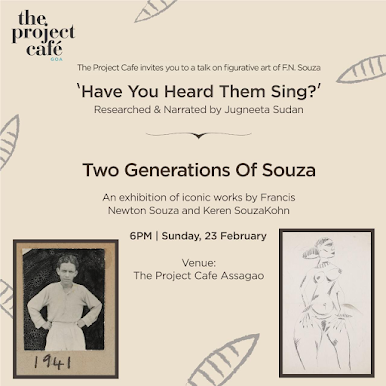
This Sunday, The Project Cafe Goa presents you to an exclusive exhibition that captures the exemplary turbulence of human identity and cultural stereotypes in post-colonial India from the perspective of an iconic Souza father-daughter duo.
The show, *Two Generations of Souza*, will bring forth Jugneeta Sudan's research and narration of works of Francis Newton under the series 'Have You Heard Them Sing' along with an exhibition of artworks by Keren SouzaKohn.
Join us at Assagao for an interactive evening at 6PM on Sunday 23 February at The Project Cafe Goa.


Thursday, December 12, 2019

"You have given my father back to me!"


GALF Gleanings!
Chuffed to bits!
The most wonderful appraisal of my presentation on
FN Souza at GALF, from writers, artists, filmmakers, and gallerists!

Keren Souza, Souza's daughter, a British artist in her own right said, "You have given my father back to me!"
'Critic as an Artist' - My 5 yr old research project on FN Souza's art practice, births new dialogue around his highly controversial figurative art legacy, the study of human sexual life and relationships.
While Keren Souza, Sonia Rodrigues Sabarwal, Arjun Menezes designed the display "Portrait of the Young Artist"
Shaistha Thapar set up the art gallery - a viewing of masterpieces of FN Souza at the event.

Graphic Design - Apoorva Raina


Monday, December 9, 2019

FN Souza at Goa Art /Lit Festival 2019

Getting ready for my presentation on FN Souza at Goa Art /Lit Festival  

Display of FN Souza paintings at GALF morphed into graphic design (painting + photograph), a mosaic meticulously designed (by
Apoorva Raina
) within a 1941 black and white photograph of the young artist :
Portrait of the Young Artist 1941 (17 yr old Francis Newton)
I essentially like this photograph because of the rebellious stance and the fiery look in his eyes. A 'Rebel Prodigy' who created pathbreaking work at a young age, carving the modern woman on his canvas. His resurrection of the new woman was a twined Cleopatra, Lysistrata, Rati, Shakti & Kali!

Keren Souza, Sonia Rodriques Sabharwal teamed up with me to decorate & mount the poster, finely titled by Arjun Menezes.


Sunday, December 8, 2019

 GALF Gleanings!

X edition of Goa art lit fest!
In conversation with New Zealand-based novelist Rajorshi Chakraborty, who cautions us that if we do not 'seize the day'....' Or The Day Will Seize Us', the title of his first novel. Other books come with more intriguing titles:
'Balloonists' (which reminded me about Krishen Khanna's Bandwallahs)
'Derangement'
The novel in the discussion was the to-be-released:
'Shakti'
The age of Right-wing politics and their subversive agendas set as a mystery thriller with 3 strong women protagonists.
Interesting and enriching interlude. Raj is as good an orator/writer as he is a listener. The exchange of ideas was scintillating, the beginning of a new art/ literary friendship!


Wednesday, December 4, 2019

FN Souza Art Presentation & Display


"A Look at FN Souza as a Young Artist"
by Jugneeta Sudan
Goa Art Lit Fest
06 Dec 6:15pm
Mandovi Hall


Monday, March 4, 2019

Souza in The 40s


When the exhibition ‘Souza in The 40s’ arrived at Sunaparanta Gallery, Goa (Dec 2019), my research on the artist had been underway for a couple of years. The exhibition, a mega event curated by Conor Macklin was held simultaneously at two other venues, Saffronart Delhi and Grosvenor Gallery London. It showcased FN Souza in the first decade of his artistic career (1940-1949), up to when he packed his bags to go to London.

I went to see the exhibition with a clear context, wanting to see the mind of an exceptionally brilliant young Souza from when he was just 16 years old to when he turned 26. And what I saw in the exhibition validated my research, as well sent me on new pathways to decipher Souza’s vision as a young artist.


Undoubtedly, with his first strokes on the canvas, Souza at sixteen had set out to study nature in its vast magnificence. Besides natural surroundings, his endeavor to comprehend nature through the human body showcased an exceptional quality, a fascination which moored him for life, that mastery of haptic quality of drawing dissecting the nature of human form. But what was utterly riveting was the truly remarkable, in a definite class of its own, the avant-garde portrayal of women by a boy artist just 16, 17 ....18 years of age. 

His nudes in the gallery sketched with admirable adroitness made me stop short. Women erotic and sensual, echoing the susurrations of symbolists yet in complete command of their bodies ; utterly unselfconscious voluptuous women laughing singing and running on the beach in swimwear, or at their toilet beside a flowing stream, with one of them playfully kicking a stone on the river bank. These were magnificent human beings, absolutely natural and earthy as if he had conspired with nature to bring together beauty and mystery in harmony with the universal laws governing life and matter. In a cultural context of two millennia human civilization, these completely as ease women in these artworks in the 40s’ executed by a young mind are no doubt outstanding. 

Friday, February 8, 2019

FN Souza : Art India


My piece on FN Souza's Figurative Art in Art India, Jan 2019
                                         
                                       The Female Nude: Picture of Self-Possession 

........‘the return to tradition’ in post-independence period re-establishes forms and conventions colonialism had disrupted and that this restoration (or should be), the most significant event in modern Indian art both in itself and as the instrument of cultural decolonization. The aforementioned move is best exemplified by the rebirth of Female Nude in FN Souza's art. Drawing from global art practice beginning with prehistoric art, he carved her 'Bold & Beautiful', and this representation lies coded a social revolution for contemporary human society.  

  That Souza’s art contains various possibilities of redemption is yet to be understood. If society is to become free, the answer lies with liberated men and women, the ultimate egoists. Contrary to her jaded erotic image, in Souza’s work, this nude is not exposed and vulnerable, but assertive and powerful. She is emphatically nude, not naked. Beneath the compelling line of Souza’s female forms lies his artistic vision that needs to be fully comprehended. 


Sunday, December 9, 2018

FN Souza - A Life of the Mind


I had walked in one day because I had seen the golden nude through the rose-tinted 
window glass of the exhibition gallery. That was weird, I thought, seeing 'Myself', in a striking
nonchalant pose on a canvas, where one might have expected the guilt-ridden, bashful
Venus Pudica types, with a perpetual blush marking her countenance or the prevalent supine,
spreadeagled 'SHE' forms. They told me the famous and in other ways not so famous artist,
FN Souza was dead.
I was reborn with my contemplation on flesh and its fall, and it's resurrection in FN's art,
'till I shone again with the light of first sight' 

Great art remains alive because of its power to evoke a response in the viewer. The prevalent thrust in my writing towards 'critic as an artist' births new perspectives of existing ways of seeing. That Souza’s art contains the greatest social possibility is yet to be understood. An interdisciplinary lens on Souza's work opens portals to alternative perspectives, generating new dialogue on his artistic legacy.

Souza was definitely an outlier. Shaking pedestals of propriety, he rebelled to render radical art. 
Despite his innovative disposition, the priggish Indian sensibility disregarded him with Pecksniffian relish for his sexually overt portraiture, and racism and western supremacy pigeonholed him abroad. That this art legacy at par with Bacon and Picasso is still to find its place in the world art canon, propels his scholars and critics to work towards that goal. 

My endeavour is an extension of my personal journey and a deep connect to FN Souza's art. I bring my strength of an open mind, interdisciplinary reading and a totally fresh look at Souza's art and mind.

There is no denying, it's definitely an impressionist take, a Florilegia dedicated to FN.


The first essay is an introductory essay. The next four are based on his most controversial work in figurative art - 'The Female Nude'. Thereafter the essays focus on his Self-portraits, Passion series and other themes in his artistic oeuvre. I have completed 10 essays and I plan to write 15 essays in all.  

I thought it best to go with a florilegium so far. I was going against the grain ( established viewpoint of Souza's figurative art)  and building an argument towards a more feminist frame -  how a shift in my own consciousness made me see those emancipated women in his figurative art, an altered perception that unraveled a whole novel and radical definition of his art practice. 

Now that I am midway through, hereafter my essays will incorporate short story formats and an ekphrastic style. 


I also gave a talk on Souza at Fundacao Oriente, The Story of Space Festival, 2017 and the Goa Pavilion, Serendipity Art festival, 2017. 
I am gearing up to present my essay at Panjim 175, SAF  15th - 22nd Dec 2018 https://www.serendipityartsfestival.com/          


Tuesday, February 13, 2018

In conversation with writer, CEO Infosys Foundation, Sudha Murty

Dignity- Gravity Personified!
Penguin invited me to be in conversation with Sudha Murty. writer,chairperson of Infosys Foundation, at the launch of her book :
Three Thousand Stitches : Anthology of short stories based on her experience, work and human nature, rendered in a lucid, conversational tone!
The first story from which the book gets its title; 3000 rehabilitated devdasis presented her a metaphorical quilt, embroidering their stories of life!
Highly inspiring and humbling to be in dialogue with a woman who is redefining social work in India working with prostitutes, alcoholics.......
Not CHARITY, but social responsibility which leads to social cohesion, social development and social change. Work based on justice, human rights and an acceptance of diversity! Sudha is also a part of the health care in Gates Foundation!
Narayan Murty sat through the whole event; spot him in the audience behind Baljit!
Packed house, interactive session, audience (children to adults) all ears !

Monday, February 5, 2018

Literature Post Bob Dylan's Nobel !


Panel Discussion : Literature in contemporary times post Bob Dylan's Nobel in Literature 
With Vivek Menezes, Wendell Rodricks, Jose Lourenco, Alice D' Cruz and Prema Rocha & Ibha 
St Xavier College, Goa
Don't miss fashion designer Wendell's footwear!
We rapped Shakespearean & Dylan poetry to hip hop beat!

Friday, January 5, 2018

Curating at Serendipity Arts Festival, Goa


I am curating an evening of poetry, art and music at Bento Miguel, Fontainas, the Goan art pavilion 'Konkani Surrealism' curated by Vivek Menezes at the Serendipity Art Festival
All are invited! Entry free!


Friday, 5th Jan, 2018
4:45-5:45pm 
Colours of Goan Poetry
A number of different languages coexist in Goa - Konkani, Marathi, Kannada, Hindi, English and Portuguese, enriching tongues and facilitating communication on multiple planes. The etymology of words and alphabet reveal enmeshed cultural maps akin to human genome studies. How can we disregard facts of beautiful language tributaries feeding the invisible river of syncretism? Human trajectories woven in diverse languages fill a common story pool, binding steadfast the history of a people who have seen and experienced much. We present such a symphony in the form of poetry.


Friday, 5th Jan, 2018
5:55 – 7:30 pm
Mapping FN Souza’s Art Practice: Inspiration & Legacy
A presentation by Jugneeta Sudan
&
Live art by Goan artist during the course of the presentation in engagement with Souza's art- Inspiration, Provocation or a Rebuttal
“To comprehend and appreciate (modern paintings) one must know one’s way in the world history of art, from Praxiteles to Picasso, from the Han to Manchu dynasty and from Mohenjodaro to Francis Newton”. This famous quote by the irresistible, irrepressible and incorrigible Goan artist, may imply egotism but mapping his art practice reveals grains of truth. Comprehension of his esoteric practice requires an immersion into world art, philosophy, psychology, science and the story of human evolution. Meet the world in FN Souza’s art, a legacy worth the Goan salt!


Friday, 5th Jan, 2018
7:30-8:30pm
Jazzy Zephyr: Jazz in Goa
Jarryd Rodrigues (Saxophone) & Jonathan Furtado (Guitar)
Jazz, born in the slums of New Orleans, swept the world with its swing and vitality. Its purity stems from its diversity. Its tunes harbour strains of varied musical forms. The blazing trajectory is an example of how cultures grow stronger by borrowing elements from each other. Sons of Goa took to it magnetically, riding waves of fame and glory. The gentle winds here carry a flavour of this magic till today, blowing steady sustaining souls through soulful jazzy numbers!
Jarryd Rodrigues is the great grandson of Chic Chocolate,the legendary Jazz trumpeter & Jonathan Furtado is Kp's ( my son) best college mate! Tongue in cheek!

Friday, November 3, 2017

Presentation : FN Souza: 'Uneasy on the Eye'


My engagement with FN Souza's art practice!


The talk takes the aesthete through Souza's 'Life of the Mind' : intersections of art, philosophy, psychology and science.


Friday, October 27, 2017

At the book launch: Full Disclosure - Anthology by Manohar Shetty


Poetic meditation and conversation with Manohar Shetty
A Poet Comes Clean - Thoroughly enjoyed the meditation & ultimately the literary dialogue with Manohar Shetty on his latest anthology "Full Disclosure"
Image result for navhind times full disclosure launch manohar shetty

A Poet Comes Clean
To read a collection of works of a poet is akin to reading his personal diary. Such is the experience when you read Manohar Shetty’s anthology of poems in his new book ‘Full Disclosure’. The collection (300 odd pages of heightened modern verse) contains eight volumes of previously published poems and a handful of recent poems. This publication is special, as much for the accessibility of a large part of Manohar’s work, as is his trajectory from the early 80s to present times. Covering a span of four decades, one finds Manohar evolve from matters of love, environment and home that trouble the young mind to more geriatric themes of ageing, loneliness and death.
The introduction is by the eminent late British poet Landeg White, who begins his comment with the following lines: “To watch Manohar Shetty take the podium at a poetry reading is instructive. Previous poets have left the audience soporific, but when Shetty begins reading, they spring to life. There’s just something in the authority of the diction and rhythm that immediately compels that this is genuine stuff.”
Remarkable in their steadfastness, Manohar’s poems seek the immediate and the personal. The microcosm of his intimate space, morphs into the universal in the poems. Bruce King (a towering figure in modern literary criticism) calls Manohar’s poems art forms. In his book ‘Modern Indian Poetry in English’ he writes - “his poems bring to light otherwise unshaped, often inarticulate, deeply introspective feelings.”
The hallmark of a poet is that he lives a life subsumed in reality and mines simple truths from it; enveloped by solitude so profound that he has the facility to hold a magnifying lens to the nooks and crannies of the surrounding world. At this Manohar is artful as he discerns the arriviste and the insouciant in his vicinity as also psychological shadows of prosopopoeia ‘for the condemned man in his cell’ or the menace of death that ‘grows in your coffin like a toenail.’

‘Guarded Space’, his first book of poems begins with ‘Fireflies’. Manohar deftly juxtaposes innocence and experience and echoes William Blake’s poems ‘Songs of Innocence and of Experience’. Gay fireflies like ‘flashing streamers’ or ‘wavering lanterns’ ‘stare like luminous dials’ when bottled by children. ‘Worried by coarse hands, the walls of glass’ they soon ‘wilted to lifeless specks’. The child poet didn’t feel much then - a small loss of a ‘boy’s ornament’.
But now,
Travelling my daily groove
In the hunt for food and habitat,
I remember their trapped blank lights.

In ‘Legacy’, a sheaf of love poems, Manohar dwells upon the man-woman relationship – a miasma of conflicting emotions, where love mingles with lust, filial relationship, sexual violence, hate and lacerations. These lines from ‘Foreshadows’ delineate the first flush of tender love, enmeshed with lust.
Waiting for the shy click of heels
on the stairs, I watch a deep
forest rise from my hands
to be soon enmeshed by lust and devouring tendencies.
A faint smell of musk enters
as I lope across the wall
My mouth exposes hungry tusks
and hands reach out like paws…

And then ‘Moored’ in a quintessential Souza-esque style of painting couples, does them in; the chafe, graze, scratch, rasp… 
They lie tied to swirling beds.
Toss in the restless darkness.
Cupped brows chiselled
For movement. They
Lurch closer, bodies chafe
And whisper, wince at each
Touch of the wind.

Shifting the lens to the brilliant craft of the poet - the marked economy, understatement and visual shape of the poems. The form is stanzaic, and lines appear to have regular length except for a few exceptions. Intermittent use of internal rhymes imparts rhythm, and rarefied poetic diction lends richness to the verse. The reader is compelled to reach for the dictionary, to reinforce the syntax and mot juste in his poetry. His metaphors are a delight to perceive and assimilate. They linger with the reader long after the poems have been read and put away.
Ants

Bodies like puffed rice,
Jaws grinding busily,
The swaying swollen heads
Lifting in flanked procession
The palanquin of flesh.

Animal poems form a large part of Manohar’s canvas. It’s interesting to behold that the technique is a synthesis of DH Lawrence and Ted Hughes, two major English poets who used animal imagery in their works to comment on the human condition. Ted Hughes wanted to write about the ‘crowness of the crow and the foxiness of the fox.’ Manohar sometimes brings in the mythic and ferocious lens of Ted Hughes to bear upon his animals. At other times, he uses a softer note, depicting them in their natural forms much like DH Lawrence.
Sting
The honeycomb is what
We are, an amphitheatre
Of geometric cells
Droning to an
Audience of one—
Head swaying like a wand,
The imperious queen
With a sweet tongue
Listening in, wings
Rippling in applause,
And killing us off
One by one.


Praying Mantis

her face
A swaying
Equilateral
Triangle like an
Alien’s, her
Panoramic
Quizzical eye
Rolling round for
A suitable partner.

His progression is structured and not necessarily linear. In no time an image that he begins with offers unconventional emotion through association. If ‘The faces drifting like apparitions’, has connotations of the precise imagism of Ezra Pound; ‘His face etched against the decay that rose and crammed the entire mirror’ leans towards Oscar Wilde’s, Picture of Dorian Gray. In his poem ‘Floorshow Bombay’ – ‘Smoke-screened sighs escape/From the redly-lit audience when she bends/Crabwise instead’, becomes a Mario Miranda painting and ‘Powdered labourers wait in a queue’, a Raghuvir Singh photograph. These are just some of the many examples of synaesthesia at work is his poems.
In the footsteps of Nissim Ezekiel, ‘Lexis Local’ is the poet’s exploration of evocativeness of Indian English idiom in poetry. Landeg is so taken in by the sound of it; he encourages Manohar to continue this experiment where the focus of attention is not the accent and stress but the entire syllabic length.
For Emily and Mahess it was,
As they are saying, love at first sight.

Self–portraits are revelatory, highly instructive and intimate. Human relationship to mirrors rides a layered love/hate crest and trough wave-like pattern. But, Manohar’s lens remains steadfast and clear on self, through elevated and despairing life strokes. His humility and introspective spirit is ferocious, pinning down tints and fractures alike.
In my drinking days, I never slept,
Only passed out and woke up
My eyes red as Mars, my head
A rattling alarm clock, amnesiac

His later poems smell of nostalgia, ‘when Macintosh was a raincoat and email a shade of blue. Inkpot, quill and curlicue longhand’ the ubiquitous writer’s companions. Fondly he recalls black/berries picked up on/a remote forest trail.’ He laments the obscurity of real scholars today contrary to the facility of the click of a mouse, which makes a dozen stand tall.
I bow sadly to my young
Charges and their instant knowledge
Borrowed with a simple click
Of a button from a universe
So ably charted and empirically
Established by my peers
And their prophetic wisdom.

Ensconced in deep thought he then begins a meditation on old age, a heavier step and a presence linked to absence. A deliberation not born of anger, injustice or pulsating fervours but slow observation –and a fierce scrutiny. The poet dwells on different ways of dying and is bewildered by the syndrome of people passing away, ‘without so much as a, take your leave.’

Blown away by Camus
And Neruda and on the road with
Ginsberg and Kerouac
Now his heartbeats are the falsetto
Of a goods train on a creaking
Bridge over a river rank with
Debris.

Cosy, intimate conversations with himself and his first family continue interspersed with birdy, snaky and spidery dialogue. Imbuing his verse with poetic fallacy, Manohar interprets the meaning of nature bringing ever new perspectives into folds of human comprehension. “Poets are natural born schizoids/And psychoanalysts/Have no answer to them.” His homilies, asides and marginalia presented between long verses are home truths, which jolt the reader with their stinging quality.
I don’t know the meaning
Of such homilies
As united we stand
Or we’re all
Part of a family.
Even the lamb
Is alone in its
Death rattle.

He made Goa his home in the mid-80s but didn’t write poems on Goa for a long time after settling here. With time the alienation abated, he felt better and ‘Returning home after a difficult day’, he wove poems around the Goan landscape, ‘the drifting wisp of thought and image…snatched miraculously from mid-air and made palpable on paper.’
Mining Gallery, Goa

We’re the avant-garde
Landscape designers
Leaving for posterity
A palette of red ponds,
Freshly dug earth
Sculpted into bald hills
And lunar ravines
The ream of new verse at the end of this anthology signifies that heart and hearth will keep fuelling Manohar’s diary writing and he will continue to show his readers the way towards some resolution of their inner scape in relation to reality.